Give Every Item a Clear Home (And Why It’s Always a Work in Progress)
I want to be upfront about something before we get into this: giving every item a clear home is not something I have figured out once and never thought about again. It is something I revisit constantly. Seasons change, kids grow, new things come into the house, and systems that worked beautifully six months ago quietly stop working. This is one of the most practical things I do to keep our home functioning — and it is genuinely never done. If you came here hoping for a post from someone who has it all sorted, this is still the right post. I just want you to know what you are actually signing up for.
Why a Clear Home for Every Item Changes How Your Space Feels
When something does not have a designated spot, it drifts. It ends up on the nearest flat surface, migrates between rooms, piles up somewhere it was never meant to be. That low hum of disorder you feel even in a reasonably tidy room — that is usually this. Not clutter exactly, just things without a place to land. Giving every item a clear home is one of the most practical things you can do because it reduces the number of small decisions everyone in your family has to make every single day. When the spot is clear and consistent, putting something away becomes automatic. When it is not, every single tidy-up requires a small act of problem-solving: where does this go? Multiply that across every item in the house and it becomes a real source of daily friction that nobody can quite name.
One thing worth saying before we go further: if items in your home do not have clear homes because there are simply too many of them, no amount of reorganizing will fix that. You cannot assign a home to something when there is no space left. I wrote a whole post on simplifying before you organize that is worth reading alongside this one. This post assumes you are working with a volume your space can reasonably hold.
The Three Questions I Ask When a Home Is Not Working
When I notice something has stopped having a clear home — or never really had one — I run through three questions. I did not sit down one day and design a framework. These are just the things I have found myself asking over and over until they became habit.
The first is whether the item actually has a home at all. Not a vague general area, but a specific spot it consistently returns to. Some things genuinely have no designated place and just get set down wherever there is room. That is the starting point.
The second is whether that home makes sense for where the item actually gets used. This is where a lot of systems quietly fall apart. If the home is too far from the point of use, things will not make it back. Shoes that belong in an upstairs closet will end up by the front door every time. A charging cable that lives in a drawer across the room will end up on the counter. The home has to be close to where the thing is actually needed.
The third is whether the home is easy enough to use consistently. A home can be perfectly logical and still fail if it takes too many steps. A bin with a lid a toddler cannot open independently, a drawer that is already too full to close easily, a shelf that requires moving three things to reach one thing — these are homes that look right on paper but do not function in real life. Ease of use is what determines whether a system actually holds.
What This Looks Like With Toys and Kids’ Items
This is the category I revisit most in our home, and honestly the one that has taught me the most about how these systems work. As new toys come in, as favorites change, as my daughter grows into different kinds of play, the homes that worked a few months ago sometimes just stop working. And the signal is always the same: things start appearing somewhere they do not belong.
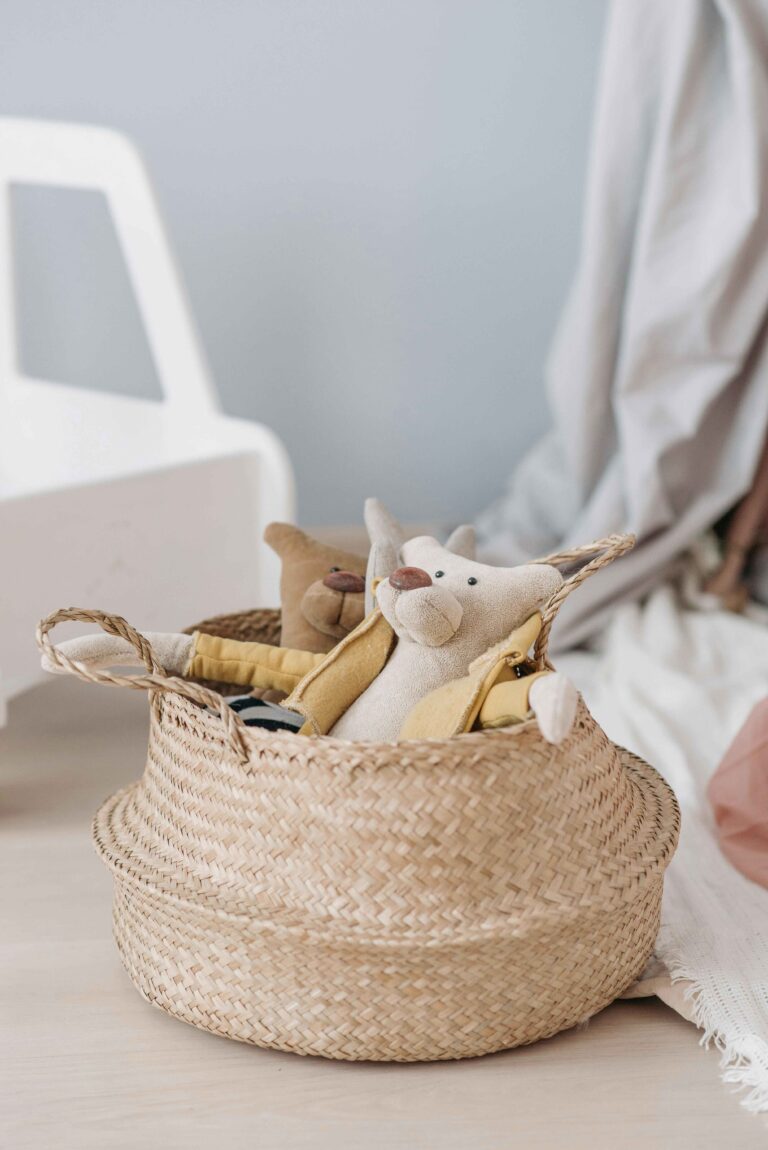
For us it is usually the ottoman, the loveseat, or the craft table. When I see toys piling up there, my first instinct used to be to redirect or tidy. Now I take it as a sign to look at the system. Almost every time, there are one of two things going on. Either a favorite toy has migrated to a different room because that is where it is actually being played with most — which means its home needs to move too, not the toy. Or the home is not accessible enough. The basket is too full to put things back neatly, the shelf is too high for independent use, or the system requires more steps than a young child will consistently follow.
The fix is usually simpler than I expect. Move the home to where the item is actually being used. Make it easier to access independently. And if things are consistently too crowded to put back neatly, that is usually a volume problem worth addressing before anything else — which circles right back to simplifying first.
Books fall into this same category and the same principles apply. Visible, accessible, close to where the reading actually happens. Our best reading happens on the couch, so that is where books live.
What This Looks Like With Paper
Paper is a category I have had to make genuine peace with, because I cannot deal with every piece the moment it arrives. Some days it takes a day or two. Sometimes five. What I needed was not a perfect system — it was a home for paper-in-progress that kept it off the counter without requiring me to deal with it immediately.
What we landed on is a set of three wire hanging file folders that connect vertically, hung near our kitchen entryway over a rolling cart that functions as a stationary buffet. That cart also holds our family command center — the meal plan, shared calendars, task lists — and a basket that serves as the drop spot for keys and wallets. The file folders fit right into that same corner, which means paper gets sorted the moment it comes in and stays out of sight on the counters while it waits. Three categories: shred, file, and to-do. Simple enough that using it takes no thought.
I am planning a full post on our family command center setup — what we have tried, what has not worked, and why this arrangement has stuck — so I will not go too deep here. The short version is that the best home for paper is one that is visible enough to remember, close enough to actually use, and simple enough that it does not require making a decision every time. Batching the processing — a week’s worth of shredding at once, then filing — also turns out to be far easier than dealing with each piece as it arrives.
A Few Other Categories Worth Naming
Everyday carry items — keys, bags, sunglasses, wallets — are worth solving first if they regularly cause morning friction, because the stakes are highest. A hook or tray near the door you actually use is almost always the answer. The home has to be at the point of arrival, not somewhere more organized but farther away.
For kitchen items like Tupperware and small appliances, the home should be as close to where they get used as possible. This sometimes means keeping less so what remains can actually live somewhere accessible. A cabinet that requires excavation to reach something is not a functioning home, it is just a storage problem that has been contained.
Cleaning supplies are worth thinking about room by room rather than all in one location. A small caddy on each floor means the supplies are already where the cleaning happens, which removes one more reason to put it off.
How to Start Without Overhauling Everything at Once
Pick one category — whichever creates the most daily friction for you right now — and walk through the three questions for anything that does not have a settled home. Does it have a home at all? Does that home make sense for where it gets used? Is it easy enough to use consistently? Then make the smallest adjustment that honestly improves the answer.
Do not try to do this for every room in a weekend. One category done well and revisited is worth far more than five categories overhauled and abandoned. And plan to come back to it. That is not a failure of the system — it is just what maintaining a home with real people in it actually looks like. The goal is not to find the perfect arrangement once. It is to stay attentive enough to notice when something has quietly stopped working and adjust before it becomes something you are managing instead of something that is working for you.